
Best Chutneys to Buy Online in India: Mint, Tamarind and Homemade-Style Flavours
Ask any Indian what's missing when food tastes flat, and the answer is almost always the same: chutney. That small bowl sitting next to a plate of samosas, idli, or chaat does something no spice or seasoning inside the dish can replicate. It adds freshness, contrast, and a hit of flavor that ties everything together.
The problem is that good chutney takes effort. Fresh mint chutney needs green coriander, mint, ginger, lemon, and a working blender. Coconut chutney requires fresh coconut, curry leaves, and a proper tempering. Imli chutney needs tamarind soaked, pressed, strained, and cooked down with jaggery and spices. On a weekday, when you want chaat at home or need to pack something for travel, making chutney from scratch is not always an option.
That's exactly why people look to packed chutney to buy online in India as a practical solution. When the quality is right, a packaged chutney can deliver the same flavor as homemade, without the prep time.
This post covers the three main Indian chutneys worth buying online, what makes each one great, what to look for in a packaged version, and where the best places to buy ready-made chutney online in India actually are.
Why Indian Chutney Deserves More Attention Than It Gets
Chutney is not a condiment in the Western sauce sense. In Indian cooking, it's a flavor component with a defined role. Each variety serves a different purpose at the table.
Here is a quick breakdown of how the three major chutneys function in Indian meals:
-
Green chutney (mint and coriander): Bright, fresh, slightly spicy. Used with snacks, street food, sandwiches, kebabs, and as a spread.
-
Coconut chutney: Creamy, mild, slightly nutty. A staple with South Indian breakfast items like idli, dosa, and vada.
-
Sweet tamarind chutney (imli chutney): Dark, thick, sweet-sour-spicy. The defining condiment of North Indian chaat.
Each one is irreplaceable in its context. You can't use imli chutney with idli. You can't use coconut chutney with pani puri. The right chutney completes the dish.
The Challenge with Packaged Chutneys
Most people who have tried packaged chutneys from supermarket shelves know the disappointment. The green chutney is too pale, too salty, or has an artificial aftertaste from stabilizers. The tamarind chutney is either too sweet or lacks the spice depth that the street food version has. The coconut chutney tastes nothing like what you get in a South Indian restaurant.
Here is why this happens. Good chutney depends on fresh ingredients and proper preparation. When brands cut corners on ingredients or over-process for shelf life, the flavor suffers. The fix is choosing brands that use actual ingredients, preserve them well through freeze drying or vacuum sealing, and skip the artificial additives.
That's the standard to hold any packaged chutney to. Let's break down each variety with that lens.
Green Chutney: What to Look for in the Best Mint Chutney Brand with Authentic Homemade Taste in India
Green chutney goes by different names across India. In Mumbai and Maharashtra, it's the coriander-mint paste that goes on vada pav, pav bhaji, and sandwiches. In Delhi, it's the chutney that shows up alongside every chaat plate, tikki, and samosa. In South India, a variant with coconut and green chili serves a similar role.
The best version uses a combination of fresh coriander and mint leaves, green chili for heat, ginger for warmth, garlic or asafoetida for depth, and lemon for brightness and preservation. The balance between these six components is what separates a flat, watery green chutney from one that tastes genuinely homemade.
What to look for when buying:
-
The color should be a deep, vivid green. Pale or olive-colored green chutney usually means the herbs were not fresh when processed.
-
The texture should be smooth but with some body. Watery chutney has been over-diluted.
-
Check the ingredient list for actual herbs, not "natural flavoring" as a substitute.
-
A small amount of lemon or citric acid is acceptable and acts as a natural preservative.
How to use it:
Green chutney works as a dip for samosas, bhajias, and pakodas. Spread it on bread for a Mumbai-style sandwich. Use it as a base for chaat. Mix it into dahi for a quick green dahi chutney. Serve it alongside kebabs or tikka as a cooling contrast.
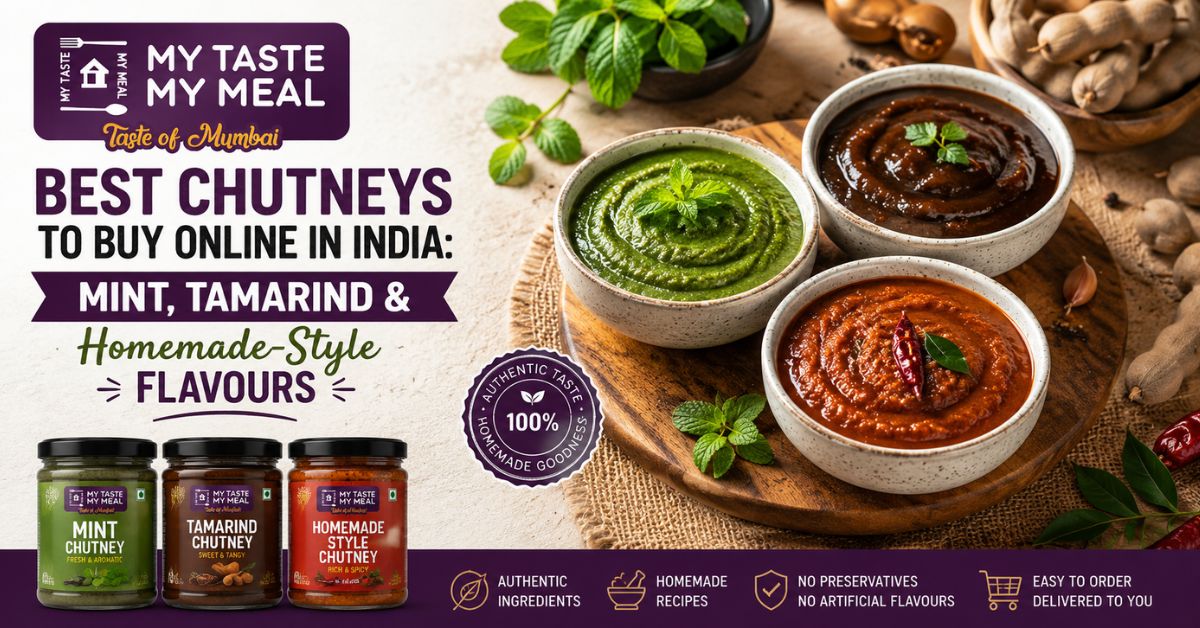
Available at My Taste My Meal: The Green Chutney is priced at Rs. 135 and is made with authentic Mumbai flavor, using the same herbs and spice balance that Mumbai street food is known for.
Coconut Chutney: The South Indian Table Essential
Coconut chutney has a regional specificity that the other two don't. While green chutney and imli chutney appear across North and West India, coconut chutney belongs to the South Indian breakfast table. It's the default accompaniment for idli, dosa, medu vada, uttapam, and pongal.
A proper coconut chutney has three layers of flavor. The base is fresh coconut ground with roasted chana dal, green chili, ginger, and salt. The second layer comes from the tempering: mustard seeds cracking in hot oil, curry leaves, dry red chili, and sometimes urad dal. The third layer is the natural sweetness of fresh coconut itself.
The challenge with packaged coconut chutney is that fresh coconut loses moisture and flavor quickly. Good preservation is what separates a quality packaged coconut chutney from one that tastes stale.
What to look for when buying:
-
Coconut should be the first or second ingredient, not just a minor addition behind starch or preservatives.
-
The tempering flavor should be present, meaning mustard, curry leaf, and red chili should feature in the ingredient list.
-
Avoid products with a long list of stabilizers, thickeners, or artificial flavor enhancers.
-
Texture after rehydration or opening should be smooth and creamy, not grainy or separating.
How to use it:
The primary use is with idli and dosa. It also works as a dip for medu vada, rava idli, and appam. Some people use it as a spread on toast or as a side with rice and sambar. In Kerala cooking, coconut chutney sometimes is served alongside fish or chicken preparations.
Available at My Taste My Meal: Coconut Chutney is priced at Rs. 135 and is available to add to cart, made with authentic South Indian flavors.
Sweet Tamarind Chutney: The Soul of Indian Chaat
If green chutney is brightness and coconut chutney is comfort, sweet tamarind chutney is depth. Imli chutney, as it's commonly called, is the thick, dark, sweet-sour-spicy sauce that turns a simple puri into a fully loaded pani puri, lifts a plate of papdi chaat into something extraordinary, and makes aloo tikki taste like street food rather than a plain potato cutlet.
The preparation is labor-intensive. Tamarind soaks overnight, gets pressed through a sieve, and then cooks down with jaggery, black salt, roasted cumin, ginger powder, red chili, and sometimes dates for additional sweetness. The ratio of sweet to sour to spice is what defines each cook's version. In Gujarat, the imli chutney is sweeter and thicker. In UP and Delhi, it's tangier with more black salt.
This complexity is what makes good packaged imli chutney genuinely hard to find. Most supermarket versions are either cloying with sweetness or so sharp with tamarind that the balance is completely off.
What to look for when buying:
-
Tamarind should be the primary base, not tamarind extract or concentrate substituted with vinegar.
-
Jaggery is preferable to refined sugar as the sweetener, both for flavor and health reasons.
-
Black salt (kala namak) and roasted cumin are the spices that give imli chutney its distinct character. Check that they appear in the ingredient list.
-
Consistency should be thick and pourable, not runny.
-
Color should be a deep brown-black, not a thin orange-red.
How to use it:
Imli chutney is non-negotiable for any chaat: pani puri, bhel puri, sev puri, dahi puri, papdi chaat, aloo tikki, samosa chaat, and ragda patties. Drizzle it over dahi vada. Use it as a dipping sauce with samosas when you want a sweet-sour contrast instead of the usual green chutney. Mix it with green chutney for a balanced two-chutney dip.
Available at My Taste My Meal: Sweet Tamarind (Imlie) Chutney is priced at Rs. 135 and is available to add to the cart, made with the authentic sweet-sour-spicy profile that Mumbai street chaat is known for.
Side-by-Side Comparison: Which Chutney for Which Occasion?
|
Chutney |
Base Flavour |
Best Paired With |
Regional Association |
|
Green Chutney |
Fresh, herby, spicy |
Snacks, sandwiches, kebabs |
Pan-India, esp. Mumbai and Delhi |
|
Coconut Chutney |
Creamy, mild, nutty |
Idli, dosa, vada, uttapam |
South India |
|
Sweet Tamarind Chutney |
Sweet, sour, spicy |
Chaat, samosa, puri |
North Indian, Mumbai street food |
Why Buying Packed Chutney Online in India Makes Sense
Here is the practical case for ordering chutney online rather than making it at home or picking it up from a local store.
Freshness on demand. Online orders from brands that use vacuum packaging or freeze drying arrive in better condition than something sitting on a warm supermarket shelf for weeks.
Travel and hostel use. Fresh homemade chutney lasts two or three days in a fridge. Packaged chutney stays good for months and doesn't need refrigeration until opened.
Consistent quality. When you find a brand whose flavor matches what you grew up eating, you don't have to adjust every time the way you do when you make it at home.
Access across India. If you live outside a metro city, finding good coconut chutney or authentic imli chutney locally can be genuinely hard. Online ordering solves that.
My Taste My Meal ships across India. All three chutneys are priced at Rs. 135 per pack, use authentic Mumbai-style recipes, and are made with the same food preservation methods the brand uses across its full range of ready-to-eat Indian meals.
What to Check Before Ordering Chutney Online
Next steps before you place an order:
-
Read the ingredient list fully. The first two or three ingredients tell you the quality of the product. Real herbs and real tamarind should appear at the top, not starch or flavor enhancers.
-
Check the preservation method. Freeze-drying and vacuum sealing preserve flavor better than heat processing.
-
Look at shelf life. A well-preserved chutney should last several months without refrigeration.
-
Check refrigeration instructions. Most packaged chutneys need refrigeration after opening and should be used within a week or two once opened.
-
Order a variety. If you regularly make chaat at home, stock both green chutney and imli chutney. If you make South Indian breakfast at home, coconut chutney is worth keeping on hand.
FAQs About Buying Packed Chutney Online in India
Q1. How long does packaged chutney last once opened?
Most packaged chutneys should be refrigerated after opening and used within 7 to 10 days for best flavor. Before opening, vacuum-sealed or freeze-dried packs can last several months at room temperature. Check the specific instructions on the pack you receive.
Q2. Is buying packed chutney online in India a safe option hygiene-wise?
Yes, as long as you buy from brands that follow FSSAI food safety standards and use proper packaging. Check for the FSSAI license number on the product page or packaging, which confirms the product meets India's food safety regulations.
Q3. Can I use packaged green chutney for Mumbai-style sandwiches at home?
Absolutely. Mumbai sandwich chutney is the same mint-coriander green chutney used for snacks and chaat. A good packaged green chutney with the right herb balance works just as well as freshly made chutney for sandwiches.
Q4. What is the difference between green chutney and mint chutney?
The terms are often used interchangeably, but there is a slight difference. Pure mint chutney uses mainly mint leaves. Green chutney typically combines mint and coriander, which gives it a more rounded, less sharp flavor. Most restaurant and street food versions use a mix of both.
Q5. Which is the best chutney to buy online for someone new to Indian food?
Start with green chutney. It's the most versatile of the three and pairs with the widest range of dishes. It works as a dip, a spread, and a side. Once you're comfortable with green chutney, imli chutney is the natural next addition, especially if you enjoy chaat.