
Planning a Trip? Here's Why You Should Stock Ready-to-Eat Indian Food with a 12-Month Shelf Life in Advance
You've booked the flights. The hotel's sorted. The itinerary is saved on your phone. But somewhere between all that planning, most travelers forget one thing that genuinely matters once you're on the road: food.
If you've ever landed in a foreign country at midnight and stared at a convenience store shelf wondering if the noodles are even vegetarian, you know exactly what we mean. And if you follow Jain food practices or simply can't stomach a week of hotel breakfasts and overpriced airport sandwiches, the problem gets worse.
That's where pre made meals with a long shelf life become genuinely useful. Not as a last resort, but as a smart part of your travel prep.
What Makes Ready-to-Eat Indian Food Different from Regular Packaged Food?
Most packaged food you find at a grocery store relies on high salt content, preservatives, or refrigeration to stay safe. Shelf life is usually 3 to 6 months, and the taste often suffers as a result.
Freeze-dried ready to eat Indian food works differently. Here's how it works: cooked food goes into a freeze-drying chamber, where temperatures drop to around -40°C and moisture is removed through a process called sublimation. The food loses up to 98% of its water content without any heat damage. Flavor compounds, natural colors, and nutrients stay largely intact.
The result is a meal that weighs a fraction of the original, takes up minimal space, and can last up to 12 months at room temperature without any added preservatives.
To prepare it, you add hot water or heat it in a pan for a few minutes. That's it. Dal Makhani in five minutes. Pav Bhaji on a mountaintop. Veg Biryani in a hotel room with just an electric kettle.
Why Stocking Up Before Your Trip Makes Sense
A lot of travelers think about food only once they've arrived at their destination. That's usually when the regret kicks in.
Here's why planning ahead and stocking up on pre made meals before you leave is the better approach:
You avoid airport food prices. A mediocre sandwich at an international terminal can cost more than a full meal kit. If you're carrying your own food, you sidestep this entirely.
You're not dependent on local availability. Finding authentic Indian food, or even vegetarian food that meets your standards, isn't easy in every country. Some cities have one Indian restaurant; others have none within 30 km.
You eat on your own schedule. On road trips, treks, or long train journeys, mealtimes don't follow a restaurant's hours. Having a meal in your bag means you eat when you're hungry, not when something happens to be open.
It's especially useful for Jain travelers. Finding Jain food outside India is genuinely difficult. Most so-called "vegetarian" dishes abroad contain onion and garlic. Carrying certified Jain-friendly freeze-dried meals removes this uncertainty completely.
It reduces decision fatigue. Travel is already full of choices. Knowing that you have a solid meal covered for at least one part of your day is a small but real relief.
How to Calculate How Much to Carry
This is where most people either overpack or underpack. A reasonable framework:
- Count your travel days. If you're away for 10 days, plan for at least 10 to 15 meal packets. Not every meal needs to come from your bag, but having enough for one meal a day gives you a safety net.
- Factor in your trip type. A city trip with restaurants nearby needs fewer packets than a trek or a cruise where meal options are limited or expensive.
- Account for group size. If you're traveling with family, multiply accordingly. Many freeze-dried portions are single-serving, so this math is straightforward.
- Add a few extras. Delays happen. Flights get cancelled. Having two or three extra packets costs almost nothing and removes a lot of stress.
-
Check customs regulations. Most countries allow commercially packaged, sealed food items. However, always check the customs rules of your destination before packing. Some countries restrict certain categories of food imports.
What Types of Ready-to-Eat Indian Food Travel Well
Not all Indian dishes translate equally well to freeze-drying. Here's what works best and why:
Dal-based dishes freeze-dry exceptionally well. Dal Fry, Dal Makhani, Sambhar, and Gujarati Dal all reconstitute with good texture and authentic flavor. Lentils hold their structure through the process.
Dry curries and sabzis like Pav Bhaji, Aloo Bhaji, and Paneer Bhurji also travel very well. These have less liquid content to begin with, making them easier to rehydrate evenly.
Rice-based meals such as Veg Biryani, Tawa Pulav, Jeera Rice, and Rajma Rice are among the most practical options for travel. A complete rice meal in a single packet covers carbohydrates and a main dish together.
Breakfast items are often overlooked but are extremely practical. Kanda Poha and Mumbai Upma, for example, are fast to prepare and familiar enough to make mornings feel normal even when you're far from home.
Desserts and soups round out the range well. Carrying a packet of Gajar Halwa or a soup gives you something comforting when the weather or a long travel day calls for it.
How to Pack Ready-to-Eat Meals for Travel
The packaging of freeze-dried meals is already designed for portability, but a few packing habits make a difference:
- Keep packets flat in your bag to avoid tearing seals
- Store them away from liquids and sharp objects.
-
If you're checking bags, place meal packets in the middle of your clothes rather than at the edges where pressure from the bag's sides can compress them.
-
For carry-on luggage, note that liquid restrictions only apply to liquids. Dry sealed food packets are generally fine through security, but confirm this with the airline if you're carrying a large quantity.
-
Write the preparation instructions on a small card if you're traveling to a place where you might not have easy access to the original packet information.
Freeze-Dried Meals vs. Canned Indian Food: A Practical Comparison
You'll find canned Indian food at many international grocery stores, so it's worth understanding why freeze-dried food is usually the better choice for travel.
Canned food is heavy. A standard can of dal weighs 400 to 500 grams. A freeze-dried packet of the same serving weighs around 50 to 80 grams. If you're flying with weight restrictions or trekking with a pack, that difference is significant.
Canned food also has a metallic after-taste that many people notice. The high-heat sterilization process used in canning changes the flavor profile of the dish. Freeze-drying, because it removes moisture at low temperatures, preserves more of the original taste.
Shelf life is comparable: canned food typically lasts 2 to 5 years, while good quality freeze-dried Indian meals reach up to 12 months. For trip planning, 12 months is more than sufficient for stocking up weeks or months in advance.
Stocking Up in Advance: The Practical Case
A 12-month shelf life means you can treat ready to eat Indian food the same way you treat other pantry staples. Order once every few months, keep a supply at home, and pull from it when a trip comes up.
This approach works especially well for frequent travelers. If you travel four or five times a year, having a stocked supply means you're never scrambling at the last minute. You already know the products, you know the portions, and you pack with confidence.
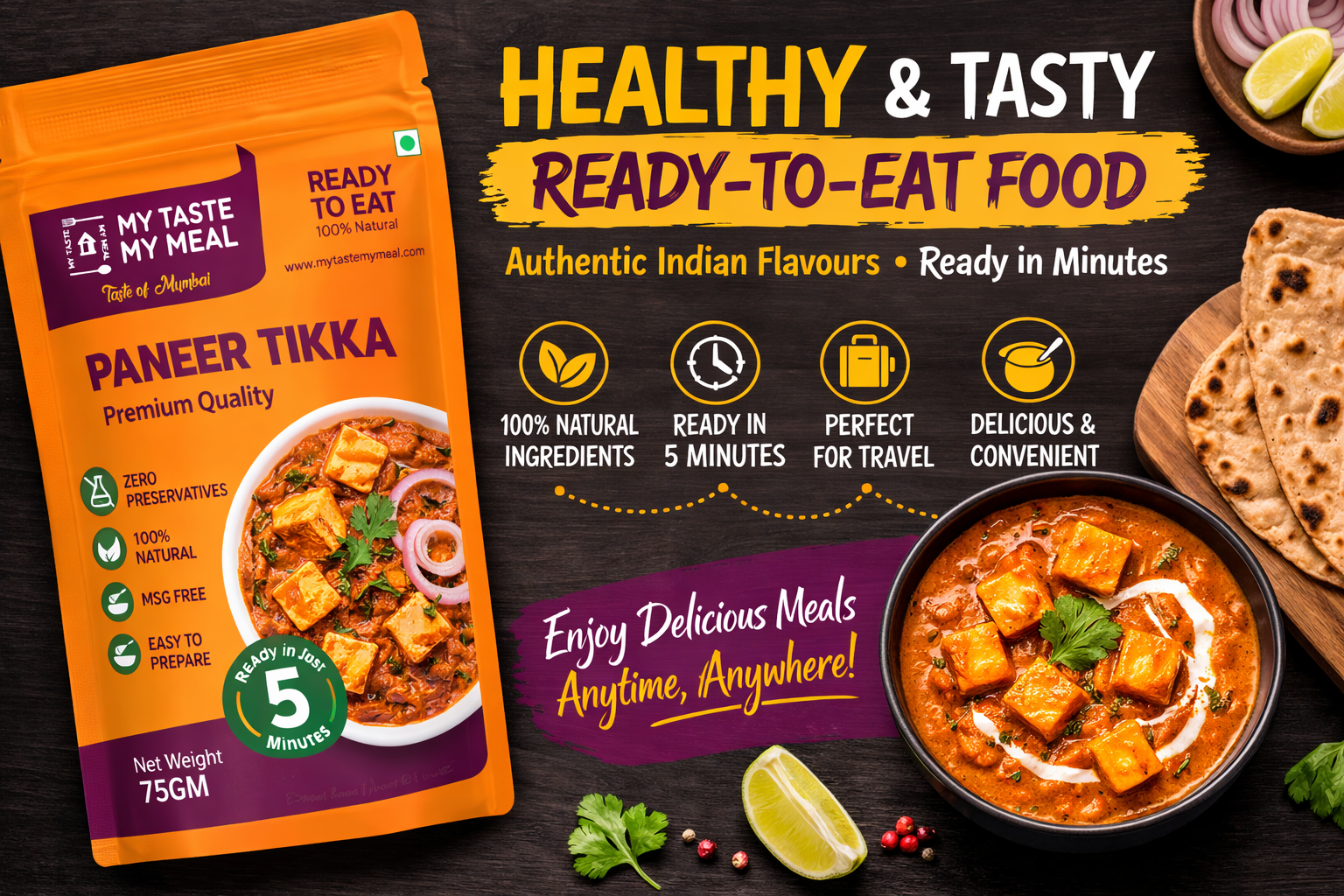
My Taste My Meal offers over 50 freeze-dried Indian meal options across categories including Meals, Dal, Rice, Breakfast, Desserts, Soups, Chutney, and Indian Breads. There are also Jain-specific options for every major category. The meals are priced between Rs. 150 and Rs. 250 per packet, making bulk buying before a big trip reasonably straightforward.
Given that the shelf life runs up to 12 months, ordering two to three months before your trip still leaves you with more than enough buffer time. If your travel plans change, the meals don't go to waste.
Who Should Be Carrying These Meals
The obvious answer is anyone traveling internationally, but the use cases are broader than that:
Trekkers and hikers dealing with altitude, limited gas supply, or no cooking facilities beyond a simple stove. Freeze-dried meals are standard gear in serious trekking kits.
Students studying abroad who want a taste of home without the effort of cooking a full Indian meal from scratch in a shared kitchen.
Business travelers who eat in hotel rooms more often than restaurants and want something satisfying and familiar at the end of a long day.
Families traveling with children who are picky eaters and need the reassurance of familiar food.
Jain travelers for whom finding compliant food abroad is a persistent challenge.
A Word on Food Safety and Shelf Life
The 12-month shelf life on freeze-dried ready to eat Indian food assumes the packet remains sealed and is stored at a moderate room temperature (typically below 25°C) away from direct sunlight. Once opened, the meal should be consumed immediately.
Look for products that clearly state the manufacture date and expiry date on the packaging. Any reputable manufacturer will include this. Avoid buying packets with damaged seals or visible discoloration, as these indicate compromised packaging even if the product is within its shelf life window.
My Taste My Meal uses hygienic packaging with sealed pouches. Based on customer reviews, even travelers who carried packets on international trips to destinations like Singapore and Qatar found the food quality fully intact.
Frequently Asked Questions
Q1. How long does freeze-dried Indian food actually last?
Most commercially prepared freeze-dried Indian meals last up to 12 months when stored in sealed packaging at room temperature, away from direct sunlight and moisture. Always check the expiry date printed on the packet before purchasing or packing.
Q2. Can I carry ready-to-eat Indian food packets on international flights?
Yes, commercially sealed, dry food packets are generally allowed through airport security in carry-on or checked luggage. Always verify the customs rules of your destination country, as some countries restrict or prohibit certain food imports, especially items containing dairy or meat.
Q3. How do I prepare freeze-dried meals when I'm traveling without a kitchen?
Most freeze-dried Indian meals can be prepared with just hot water. Pour the packet contents into a bowl, add boiling water in the quantity specified on the packet, wait 3 to 5 minutes, and the meal is ready. An electric kettle in a hotel room is sufficient.
Q4. Are there Jain options available in freeze-dried Indian food?
Yes. My Taste My Meal stocks Jain versions of several popular dishes, including Dal Fry, Dal Makhani, and Dal Khichdi, all prepared without onion and garlic. This makes them a practical option for Jain travelers who find it difficult to source compliant food abroad.
Q5. How many meal packets should I carry for a 10-day international trip?
A reasonable baseline is one to two packets per day, so 10 to 20 packets for a 10-day trip. Adjust based on how often you expect to eat out. Many travelers carry fewer packets for city trips and more for treks or remote destinations where food options are limited.